TNO072: Connectivity and Community
Scott Robohn had me on Total Network Operations to trace the path from a Commodore VIC-20 to a dial-up helpdesk in Cleveland to the US Networking User Association, including the day I locked myself out of 34 DSLAMs.
 11 September 2026 · 3 min read
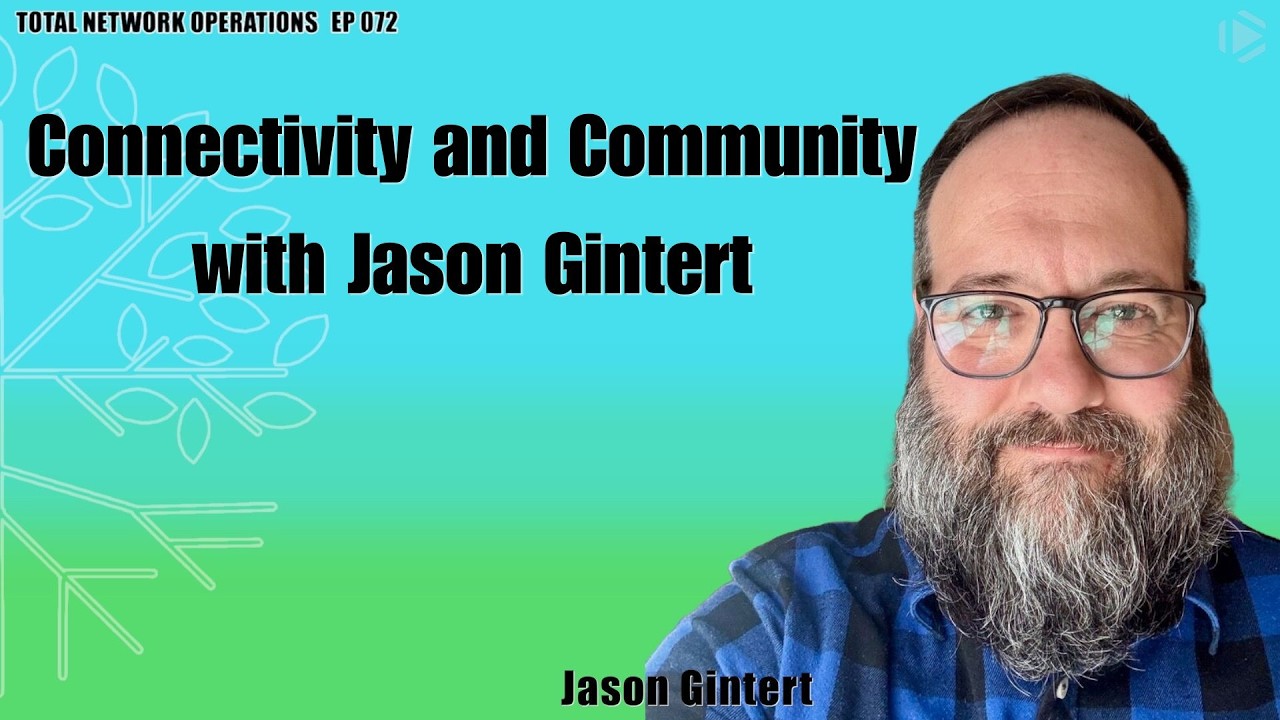
Total Network Operations, a Packet Pushers podcast. Episode 72, published 11 September 2026. Host: Scott Robohn.
Scott had me on to do two things: dig into how I got here, and talk about what the US Networking User Association has become. We did both, and I told a story I usually save for a beer.
From a VIC-20 to a carrier hotel
My first computer was a Commodore VIC-20 my dad brought home from Honeywell. Five kilobytes of RAM, BASIC out of a spiral-bound manual, programs saved to cassette. I once spent hours rewriting a song in PEEK and POKE statements until it ran out of memory, at which point there was no RAM left to save it. That was my introduction to resource exhaustion.
I did not go to college. I was working at a movie theater when a manager who had moved to a dial-up ISP offered me a tech support job for a dollar more an hour. That put me on the 18th floor of the B.F. Keith building in downtown Cleveland, which happened to be the city's carrier hotel. AT&T's global IP pop was on the second floor, everyone else moved in to connect to it, and at one point ten carriers were exchanging PNIs in that building. They eventually decommissioned an elevator car so they could use the shaft for conduit. An electrician friend still has a ladder in there somewhere.
When the company was acquired and support moved to Chicago, they told us to sit tight while they found us roles. After a couple of weeks of liquid lunches on a screaming T3, a few of us got bored and started building a network out of the 2500s, 3600s and 7500 line cards in the back room. That is where I fell for networking, and where most of us got our CCNAs.
Failing at scale
I moved into the DSL group as broadband was arriving, and wrote a Perl expect script to update usernames and passwords on 34 DSLAMs across Cleveland, Columbus and Chicago. It deleted every administrative user on every one of them. Recovering them took a physical NIDI procedure on each unit and about $50,000 of professional services, in year-2000 money. I was sure I was fired. I was not, and I learned more from that than from anything in the lab.
How a beer in Cleveland became 37 groups
After about fifteen years inside service providers I founded my own company, and noticed there were user groups for VMware and Linux but nothing good for networking. In 2017 we started the Ohio Networking User Group: fifteen people at a restaurant, two rules, no selling and talk tech. By late 2019 we had 120 people at an event and engineers from Detroit, Pittsburgh and Indianapolis asking how to do it where they lived.
Then the pandemic hit. We tried Zoom happy hours like everyone else, and used the pause to turn what we had built in Ohio into a repeatable template. That became the USNUA. From a handful of chapters in 2021 we are now at about 37 groups and expect to be around 40 by the end of the year.
What a NUG is actually for
Every event opens with one question: is anyone in the room hiring? In Toledo four people stood up. The point is regional connection, the people you would otherwise only meet at a conference two time zones away, and the mentoring that used to happen in the NOC before remote work emptied it out.
Sponsors pay for the events and get a five-minute Spark Talk. They do not get a sales pitch, and they do not get the attendee list. Group leaders carry yellow and red cards, soccer-style, for anyone who forgets. We would rather be a matchmaker than a gatekeeper, and the vendors who get it, like Chris Kane, who has never once gone into sales mode, are the ones people seek out afterward.
What is coming
Opt-in sponsor workshops and roundtables before events, a platform for group leaders to run their events, a members portal with past presentations and video, and the return of the shirts through a merch store. If you are in northern Virginia, Scott's group meets in Reston. If you are anywhere else, usnua.com lists the next dozen NUGs taking RSVPs.