
Autocon4: Network Automation Gets All Grown Up

The network automation market hit $15 billion this year. It'll double to $30 billion by 2028. Those numbers would've seemed absurd a decade ago when we were still arguing whether using Ansible and Python was "real" automation or just scripting, But here we are.
Autocon4 in Austin November 17-25, 2025 brought the Network Automation Forum community together for five days of workshops and sessions that revealed something important: the conversation around network automation has fundamentally shifted. The community driving the conversation on network automation forward is now wrestling with how to build multi-platform systems that actually work at scale, how to get executives to fund them and how to get all of their team members to trust them.
A Framework That Might Actually Stick
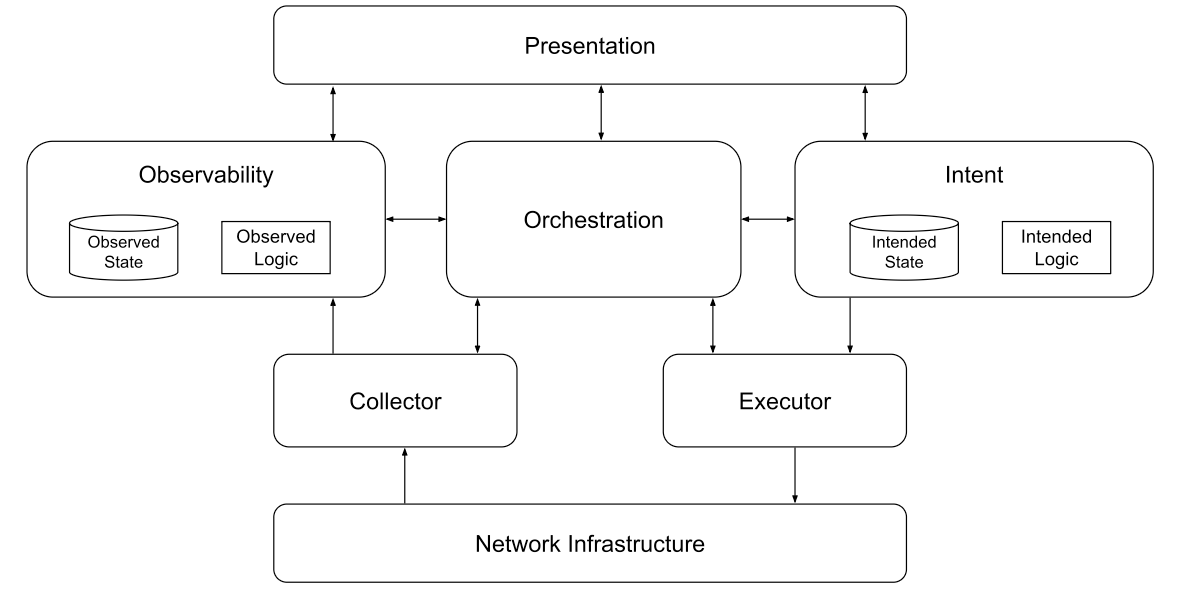
Dinesh Dutt stepped up on stage to show us the NAF Network Automation Framework and this is worth paying attention to. This framework is an attempt to define what makes automation systems actually work, built by operators, automation engineers and vendors collaborating in the open.
The framework identifies six building blocks:
- Intent: Defines the logic to handle and the persistence layer to store the desired state of the network, including both configuration and operational expectations.
- Observability: It persists the actual network state, and defines the logic to process it.
- Orchestrator: Defines how the automation tasks are coordinated and executed in response to events.
- Executor: Encompasses the actual tasks applied to the network to drive changes (e.g., updating configuration) as guided by the intended state.
- Collector: In contrast to Executor, this component focuses on retrieving (i.e., reading) the actual state of the network.
- Presentation: Provides the interfaces through which users interact with the system, including dashboards, graphical user interfaces (e.g., ITSM), and CLI tools.
Anyone who's been in this space has seen variations of these concepts. It's the explicit insistence on modularity, vendor neutrality and composability. Dinesh made the point that modern networks are large, heterogeneous and constantly changing. Ad hoc scripting and isolated tools just can't scale. The framework provides a blueprint for building systems that can evolve as networks grow more complex without requiring wholesale replacement. Just as importantly, it establishes a common nomenclature so the industry can finally agree on what we're all talking about and categorize tooling consistently.
The GitHub repo lives at the Network Automation Forum's reference repository if you want to dig in. Community feedback is explicitly welcomed. This is the kind of collaborative effort our industry really needs.
Speaking Finance, Not Just Engineering
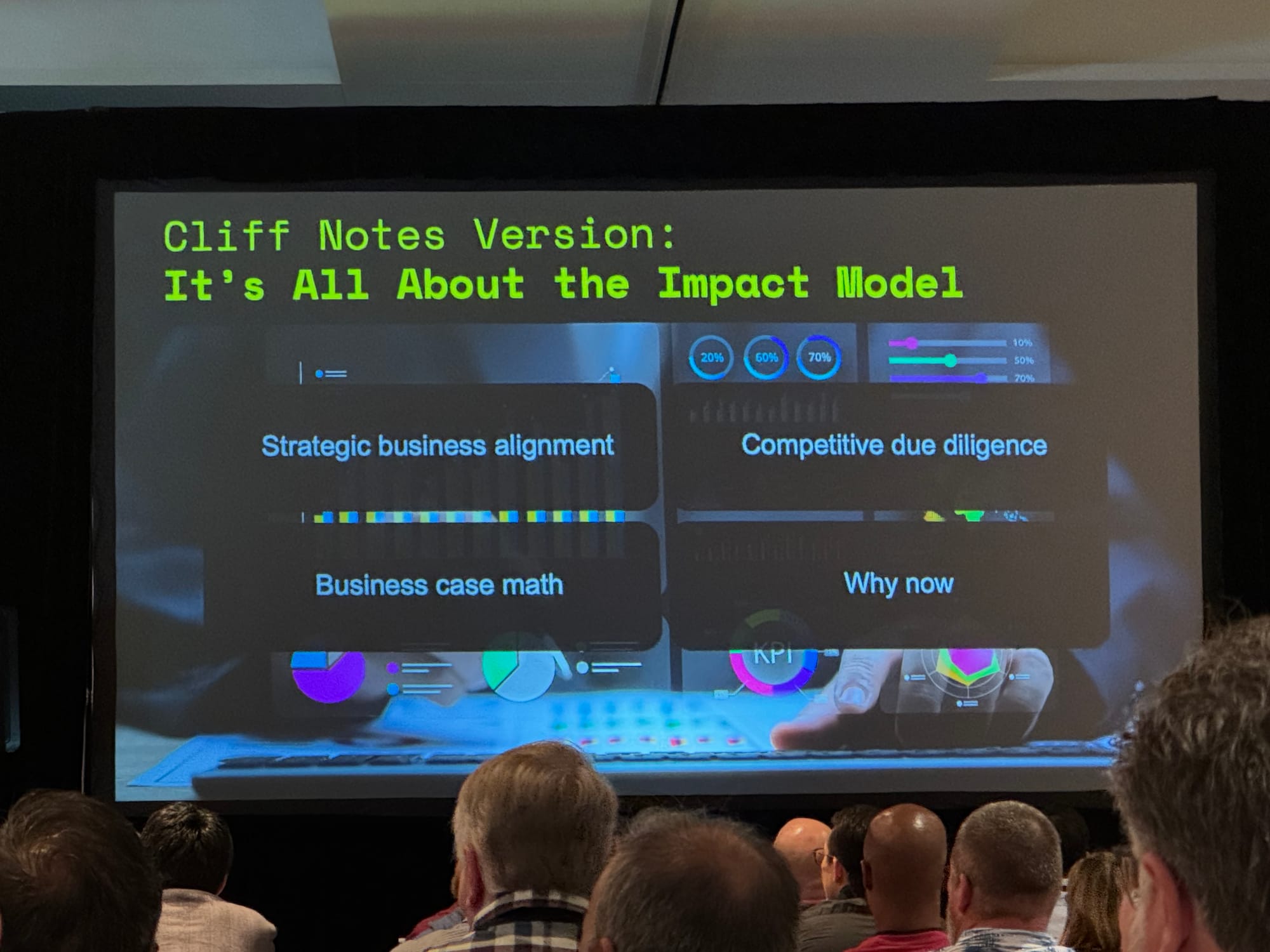
Jeff Gray the CEO at Gluware delivered what might be the most practically important session of the conference from a business perspective. His premise: the future belongs to those who can explain value of network automation to CXOs, not just demonstrate technical excellence.
The business case methodology he presented is rigorous. Gather your variables: device counts, downtime costs, staffing rates (fully burdened, don't forget benefits and overhead), changes per device annually, existing tool spend. Model efficiency assumptions conservatively 50% year one, 75% year two with full realization years three through five. Then haircut your estimates further, taking 25-35% credit against theoretical maximums.
The resulting numbers are staggering. Typical Net Present Value (NPV) for mid-sized environments exceeds $1 million. Payback periods run four to seven months which is so fast that finance teams struggle to believe them. Internal rates of return (IRR) hit 150-300%, compared to the 15% that's typical for other enterprise investments.
One customer case study reported an $8.8 million NPV projection that was exceeded in year one with over $7 million in realized savings. That's not marketing fluff. That's ammunition for the budget conversation you need to have.
CFOs prioritize in this order: revenue acceleration, cost efficiency, mission critical, nice-to-have. If you're positioning automation as a cost play alone, you're starting at position two. Revenue acceleration, faster M&A integration, quicker service deployment, reduced time-to-revenue for new locations. That's the conversation conversation that opens wallets.
The Psychology Problem
Andy Lapteff gave us one of the most honest presentations I've seen at a networking conference. He shared his journey from CLI expert to automation advocate, a path that went through being unemployed four times in one year and reaching some genuinely dark places.
His breakthrough wasn't learning Python. It was realizing he was the problem. Twenty years of avoiding automation traced back to a failed computer science class and a brain that had internalized "coding is bad, avoid bad." Cognitive bias. Negativity bias. We weight negative experiences 10:1 over positive ones.
"Until I told myself a different story, I could not learn," he said.
He used a wildebeest migration analogy that resonated. The herd gathers at a dangerous river crossing and waits until one goes. Then they all go. We need early adopters to show it's safe. The industry has been targeting the "over my dead body" outliers when we should focus on the convincible middle.
AI: Neither Magic Nor Hype
AI was everywhere at Autocon4 but I talked to many with appropriate skepticism. Sessions reinforced that network automation requires 100% accuracy. 99.9% means false assumptions, failed pipelines and potentially career-limiting incidents.
The practical sessions focused on Model Conetext Protocol (MCP), Retrieval Augmented Generation (RAG) pipelines, deterministic execution layers, and the critical importance of auditability. Senad Palislamovic walked through building AI pipelines with explicit schemas, structured outputs, and validation loops. John Capobianco traced the evolution from CLI to GPT while emphasizing that AI augments engineers rather than replacing them.
The trust progression framework from human-in-the-loop to human-on-the-loop to fully autonomous provides a roadmap for organizations who are wisely not ready to hand over the keys entirely. There seems to be a consensus around building systems that are safe, auditable, traceable THEN slowly reducing oversight to make jobs fully autonomous.
What This Means
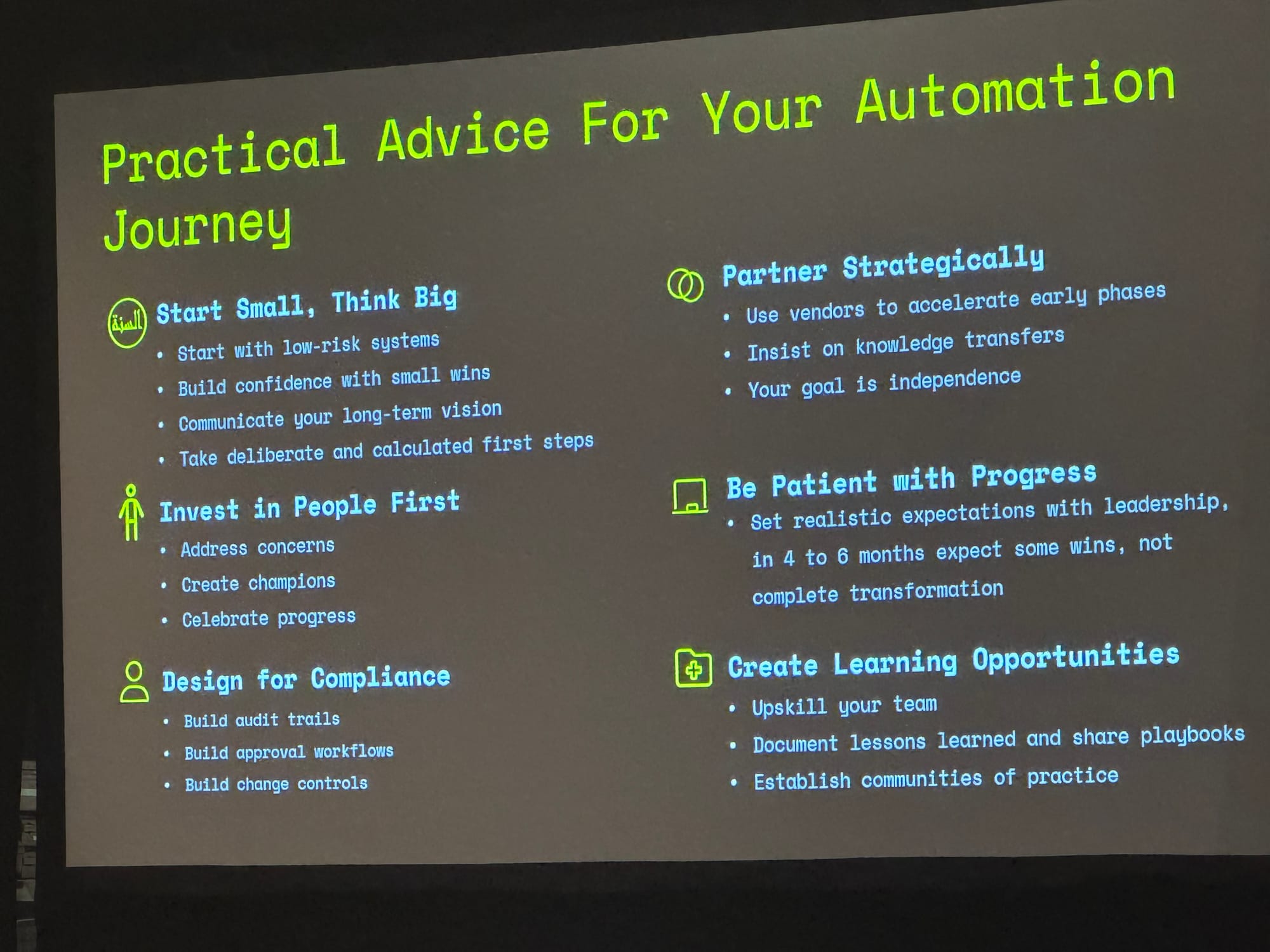
Autocon4 marked a maturation point. The technology works. The business cases are proven. The frameworks exist. What remains is organizational change with addressing psychology, building trust, speaking finance and to use Mr Lapteff's analogy, moving herds of would be adopters across the river. Sometimes, one at a time.
The question isn't whether network automation will transform our industry. It already has. The question is who will help lead the way for transformation. Will it be you?